
What is a Hot Air Balloon and How Did it Change the World?
Have you ever wondered how humans first took to the skies? The hot air balloon is an amazing aircraft with a remarkable legacy. This invention changed how we view transportation and exploration forever. As a lighter-than-air craft, it uses heated air to float gracefully through the sky.
The first successful human flight occurred in 1783, marking humanity’s triumph over gravity. Join us as we explore the fascinating journey of these aerial wonders. We’ll discover their rich history, innovative patents, and enduring appeal – including the spectacular festivals right here in Dallas, Texas.
What You Will Learn About Hot Air Balloons
In this comprehensive guide, you’ll discover:
- The fascinating journey of the hot air balloon from its invention to modern-day use.
- How the first air balloon changed transportation forever.
- Key historical moments in balloon development.
- Important safety aspects of hot air balloons.
- The evolution of balloon technology through patents.
- Modern uses and future potential of air balloons.
- Facts about balloon speeds and heights.
- Environmental impacts and considerations.
- Texas-specific hot air balloon activities and festivals.
Notable achievements and records in ballooning.
- Who Invented The First Artificial Balloon?
- The Fascinating History Of Hot Air Ballooning
- What Was The First Thing To Fly In A Hot Air Balloon?
- What Did The Hot Air Balloon Inspire?
- How Does A Hot Air Balloon Work?
- How Has The Hot Air Balloon Improved Over Time?
- Is The Hot Air Balloon An Invention Or Innovation?
- Patents That Changed Ballooning
- How to Patent a Hot Air Balloon
- What Impact Did The Hot Air Balloon Have On Society?
- What Are Some Facts About The First Hot Air Balloon Flight?
- How Fast Does A Hot Air Balloon Travel?
- Do Hot Air Balloons Go Higher Than Planes?
- Are Blimps And Hot-Air Balloons The Same?
- How Do Hot-Air Balloons Affect The Environment?
- What Is A Hot Air Balloon Basket Called?
- Hot Air Balloons Vs. Gas Balloons
- How Does A Hot Air Balloon Land?
- What Happens If A Hot Air Balloon Runs Out Of Gas?
- Wrapping Up The Hot Air Balloon – Start Your Patent Invention Today
- Faq’s
Who invented the first artificial balloon?

The first artificial balloon was invented by two brothers located in Annonay, France. The word artificial refers to the first human-made vessel capable of flight, as opposed to natural floating objects. The Montgolfier brothers, Joseph-Michel and Jacques-Étienne, created this revolutionary invention in 1783. Their breakthrough came from observing how heated air caused lightweight materials to rise.
The brothers’ path to invention started with simple experiments. Joseph-Michel noticed laundry billowing upward over fire and began testing with small silk bags. This observation led to their first successful demonstration on June 4, 1783, in Annonay, France.
Their experimental process involved:
- Testing different fabric materials for durability.
- Developing fire-resistant coatings using alum.
- Creating a scalable envelope design.
- Engineering a practical heating system.
- Establishing basic flight control methods.
The brothers’ first public demonstration used a balloon 33 feet in diameter, crafted from sackcloth and secured with 1,800 buttons. The heat source burned a mixture of straw and wool, generating hot air to inflate the envelope. This historic flight lasted 10 minutes and reached an estimated height of 6,000 feet.
The Fascinating History of Hot Air Ballooning
The fascinating history of hot air ballooning is a story of human creativity, curiosity, and the relentless need to conquer the sky. It began with early observations of rising smoke and evolved over centuries. This led to major advancements in aviation, science, and even military strategy.
Each milestone in ballooning history has expanded our understanding of the skies and redefined what’s possible. This sets up the stage for future exploration and inspires countless dreamers to look up and imagine.
Key Events in the History of Hot Air Ballooning
Here is a comprehensive timeline of pivotal moments in the history of hot air ballooning, from early flights to record-breaking achievements.
- 1709 – Bartolomeu de Gusmão demonstrated the first documented hot-air model balloon flight in Portugal.
- 1783, June 4 – The Montgolfier brothers launched their first public unmanned balloon in Annonay, France.
- 1783, September 19 – The Montgolfiers sent the first living beings (a sheep, duck, and rooster) aloft in a balloon at Versailles.
- 1783, November 21 – Pilâtre de Rozier and Marquis d’Arlandes completed the first human flight in a hot air balloon in Paris, France.
- 1793, January 9 – Jean-Pierre Blanchard made the first hot air balloon flight in America, witnessed by George Washington.
- 1836 – Charles Green set a distance record by traveling over 500 miles in a balloon from England to Germany.
- 1859 – Balloons were used for military reconnaissance for the first time during the Italian War of Independence.
- 1906 – The first Gordon Bennett Cup for ballooning was held, inspiring international competition and innovation in long-distance ballooning.
- 1960 – Ed Yost, known as the father of modern ballooning, developed the first propane-powered hot air balloon, leading to safer and more controlled flights.
- 1978 – The Double Eagle II made history as the first balloon to successfully cross the Atlantic Ocean.
- 1987 – Richard Branson and Per Lindstrand completed the first transatlantic flight in a hot air balloon.
- 1999 – Bertrand Piccard and Brian Jones achieved the first non-stop balloon flight around the world in the Breitling Orbiter 3, setting an enduring benchmark in global ballooning.
- 2005 – Vijaypat Singhania set a world altitude record of 69,850 feet in a hot air balloon, pushing the boundaries of altitude in ballooning.
You can be the next person to add on to these historical events. By patenting your idea and protecting your mark so others can see your creativity.
What was the first thing to fly in a hot air balloon?
The first things to fly in a hot air balloon were three unlikely passengers – a sheep, a duck, and a rooster. These wanderers of the wind soared for eight minutes in their historic flight.
Why these animals? The sheep’s physiology resembled humans. The duck and rooster served as the control group since they could already fly. The payload included special monitoring equipment.
King Louis XVI originally suggested sending prisoners. The Montgolfiers convinced him that these animals could better test air temperature effects at different altitudes. The flight proved that the atmospheric pressure wouldn’t harm living creatures.
What did the hot air balloon inspire?
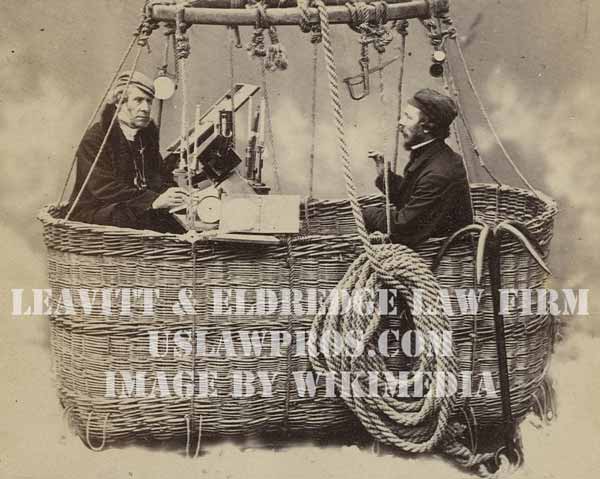
Title: James Glaisher en Henry Coxwell in een luchtballon. Messrs. Glaisher & co
Copyright: Creative Commons CC0 1.0 Universal Public Domain Dedication
Date: circa 1864
Hot air balloons inspired major breakthroughs in meteorology and weather forecasting. James Glaisher and his aeronaut partner Henry Tracy Coxwell made groundbreaking atmospheric discoveries during their balloon flights between 1862-1866. During their most famous flight, Coxwell saved their lives by climbing into the rigging to release a frozen valve. Glaisher had lost consciousness at 29,000 feet, making Coxwell’s quick action crucial for their survival.
Their hot air balloon ascents significantly advanced meteorology and weather forecasting. Their high-altitude observations provided unprecedented data on temperature, humidity, and atmospheric composition at various elevations. This data greatly enhanced the understanding of weather patterns and atmospheric behavior. These insights laid the groundwork for modern meteorological science and improved forecasting accuracy.
The 2019 film “The Aeronauts” dramatizes Glaisher’s remarkable journey. While the movie takes creative liberties, it captures the incredible dangers these early scientists faced. The film showcases how these brave aeronauts ascended to nearly 37,000 feet in wooden baskets with basic instruments.
Learn the truth about the disaster at 37,000 feet.
The invention sparked early concepts of space exploration. Montgolfier’s success inspired Jules Verne’s “Five Weeks in a Balloon” (1863). This novel influenced generations of astronauts and rocket scientists.

Balloons led to pioneering developments in:
- Aerial photography (1858, Nadar’s first aerial photos)
- Parachute design (André-Jacques Garnerin’s developments)
- Aircraft pressurization systems
- Lightweight material engineering
- High-altitude medical research
How Does a Hot Air Balloon Work?
How a hot air balloon works relies on a simple scientific principle – warm air rises. The hot air inside the balloon creates a difference in density compared to the cooler outside air. This density difference generates an upward force called buoyancy.
When the ballon pilot activates the burner, it heats the air inside the balloon. The burner uses propane tanks as fuel. Modern burners can heat air to temperatures over 100°C (212°F).
The balloon rises when the heated air makes the entire system lighter than the surrounding air. The balloon’s flight path depends on wind currents at different altitudes. Pilots control vertical movement by adjusting the burner’s intensity.
To descend, the balloon pilot allows the air inside the balloon to cool. As air density increases, the balloon loses lift. Most balloons have a vent at the top called a parachute valve. This valve releases hot air for controlled descent.
Basic components include:
- The envelope (fabric balloon)
- Basket (gondola)
- Burner system
- Fuel tanks
- Instruments for navigation
The envelope consists of reinforced fabric panels sewn together with load-bearing tapes. These tapes distribute weight evenly across the structure. Modern envelopes use nylon or polyester with special coatings for heat resistance.
Controlling a hot air balloon requires understanding air currents. Balloon pilots study weather patterns and choose launch sites carefully. They must monitor fuel levels and manage the internal temperature constantly.
Unlike airplanes, balloons don’t have steering mechanisms. Instead, skilled balloon pilots find air currents moving in desired directions. They change altitude to catch favorable winds. This makes each balloon flight unique. Hot air balloons fly for about 1-2 hours, with flight duration limited by fuel capacity. Landing requires finding suitable open areas away from power lines or obstacles. Ground crews often follow in vehicles to assist with landing and recovery.
How has the hot air balloon improved over time?
The hot air balloon has improved over time through remarkable technological advancements from its early silk and paper designs. Materials like ripstop nylon and heat-resistant fabrics have replaced traditional materials, making flights safer and more durable.
Navigation systems now include GPS and digital weather monitoring. The fuel system features improved propane tanks with precise gauges and backup supplies. Modern burners provide better control over internal temperature and lift.
Examples of improvements:
- Reinforced basket designs with impact-absorbing materials
- Advanced fabric panels with UV protection
- Digital fuel monitoring systems
- Improved venting systems for better control
- Weather radar integration
- LED lighting for night visibility
- Automated weather reporting systems
Is the hot air balloon an invention or innovation?
The hot air balloon represents both an invention and an innovation in aviation history. The Montgolfier brothers invented the basic concept, while continuous improvements transformed their original design.
Later innovations came from manufacturers like Cameron Balloons and Schroeder Fire Balloons. They developed new materials, enhanced safety features, and improved fuel systems. Each advancement built upon the original invention.
Below are a few key patents.
- Patent US3008665A (1958): Frank N Piasecki patented helicopter and balloon aircraft unit.
- Patent US3008665 (1961): Raven Industries introduced the parachute-style deflation port.
- Patent US3945591A (1973): Donald Allan Cameron invention relates to hot air balloons.
Modern balloons demonstrate this blend of invention and innovation. The basic principle remains unchanged, but new technology enhances performance. Today’s designs feature sophisticated materials and precision controls.
Patents That Changed Ballooning
The patents that changed ballooning demonstrate significant technological progress. Let’s examine some groundbreaking innovations that transformed flight safety and control.
These are few sample patents that showcase how protecting intellectual property drives innovation. Each inventor’s protected idea built upon previous advances. Their contributions continue inspiring new developments in balloon technology. Your patented invention could be the next breakthrough that shapes aviation history.
Patent US1553340A (1925) – Balloon
Ralph H. Upson invented an improved balloon design featuring several innovative elements. This patent (US 1,553,340), was issued in 1925. It introduced a distinctive equatorial band extending horizontally from the balloon’s middle. This rim provides stability by dampening vertical movement. It efficiently sheds rain and snow from the envelope. The design uses single-ply fabric laid on the bias for the upper half. The warp in adjacent gores runs in opposite directions. This eliminates the need for a net while maintaining structural integrity.
Meridian stress tapes run from the top cone to the equatorial rim. These distribute forces to the foot ropes. The balloon features a double-ply conical apex that can be manipulated. This helps shed accumulated snow. Additional innovations include a catenary band for stress distribution during inflation. A white outer surface with rubber backing reduces radiation effects. The improved appendix design enhances functionality. These features significantly improved balloon control, stability, and efficiency. They reduced ballast requirements for long flights.
Patent US3131889A (1964) – Balloon structure with release mechanism
Ed Yost an inventor was referred to as the “Father of the Modern Day Hot-Air Balloon.” He holds 21 patents on balloons and lighter-than-air mechanisms. One groundbreaking invention by Paul E. Yost (Tracy Manufacturing) was the propane burner system that made modern hot air ballooning practical.
Paul E. Yost invented a revolutionary hot air balloon with an integrated release mechanism. This invention revitalized hot air ballooning after the technology remained dormant for nearly 170 years. The design features an onboard burner system that generates hot air during flight. This eliminates the need for expensive compressed gases like hydrogen or helium. The balloon uses a lightweight dual-layer construction with a scuff-resistant outer layer. The gas-impervious inner layer helps contain the heated air.
A release mechanism at the top allows for controlled deflation during landing. This prevents dangerous wind dragging while ensuring a safe descent rate. Safety features include a parachute effect from the balloon’s base opening. An optional circumferential skirt helps slow emergency descents. The suspension system supports a rider’s seat below easily accessible burner controls. This practical design made long-duration, altitude-controlled flights economically viable. Yost’s invention formed the foundation for modern recreational hot air ballooning.
Patent US4651956A (1987) – Deflation and control system for hot air balloons
James A. Winker and colleagues invented a deflation and control system for hot air balloons. This patent (US 4,651,956) was issued in 1987. The invention features a top cap that functions as both a deflation panel and maneuvering port. A unique closure assembly secures the top cap to the balloon envelope. The system uses fixed members sewn to the balloon’s interior and releasable members that can separate when needed. When the pilot pulls a release line, the releasable members detach, allowing the top cap to open and rapidly deflate the balloon.
The design incorporates multiple closure assemblies arranged in two sets around the balloon opening. These open serially, reducing the force needed and providing controlled deflation. A separate venting portion allows for controlled hot air release during flight. This system provides redundancy, easy reinstallation, and minimal maintenance, addressing significant limitations of previous balloon deflation methods.
Patent US20040238692A1 (2004) – Hot air balloon vent
Phillip Robert Kavanagh invented an improved hot air balloon vent with a parachute-form operculum design. This patent application (US 2004/0238692 A1) was filed in 2004, building on previous balloon vent technology. The invention features a flexible operculum that covers the balloon’s top aperture, controlled by an innovative system of lines and pulleys. First control lines extend the operculum to seal the aperture.
Contiguous venting control means allow the pilot to pull the outer perimeter away from the aperture for variable opening. Optional second control means can contract the operculum toward its center for rapid deflation. This design empties hot air 60% faster than traditional parachute vents. The system provides greater control during flight, especially for smaller pilots handling larger balloons. A key advantage is the ability to reset the vent mid-landing if conditions change, offering unprecedented control and safety during critical flight phases.
Patent US11254409B2 (2022) – Superpressure balloon thermal control with low-emissivity cap and active air venting
Cyrus Behroozi and colleagues invented a thermal control system for high-altitude balloons. This patent (US 11,254,409 B2) was issued in 2022. The invention addresses temperature regulation challenges for stratospheric balloons. A low-emissivity cap covers the upper portion of the balloon envelope. This reflective covering maintains heat within the envelope at night. It also reflects sunlight away during daytime operations.
The system includes an active venting mechanism to regulate internal temperature. Sensors monitor conditions inside the balloon envelope. When needed, a ventilation assembly expels warmer air from within the envelope. Simultaneously, an air intake assembly draws in cooler ambient air. This approach maintains desired temperature while achieving selected pressure for proper buoyancy.
The system reduces stress on the balloon envelope by minimizing temperature fluctuations. By extending balloon operational lifespan, the invention enables longer-duration missions. The system operates effectively using solar power available during daylight hours. Various configurations accommodate different balloon designs, including those with separate ballonets.
How to Patent a Hot Air Balloon?
Securing a hot air balloon patent requires specific steps to protect your innovation. First, document your invention thoroughly with dated sketches, descriptions, and prototypes. This evidence proves you created the concept.
The patenting process starts with a patentability search. Before filing how to patent a hot air balloon invention, research existing patents through the USPTO database. This prevents wasting resources on previously patented ideas.
Next, determine which type of protection suits your creation. A utility patent for hot air balloon innovations protects functional aspects like new burner systems or control mechanisms. These patents offer the strongest protection for 20 years.
Working with a patent attorney specializing in aviation technology saves time. They understand how to get a utility patent for hot air balloon improvements more efficiently. Their expertise helps navigate complex legal requirements and technical language.
Your patent application must include detailed drawings and specifications. When submitting how to patent my invention for hot air balloon components, include every possible variation. This prevents competitors from making minor changes to circumvent your protection.
The examination process typically takes 1-3 years. During this time, respond promptly to any USPTO requests. Once approved, maintain your hot air balloon patent by paying maintenance fees at 3.5, 7.5, and 11.5 years after issuance.
Remember that international protection requires separate applications. If you plan to manufacture or sell globally, consider filing under the Patent Cooperation Treaty (PCT) to secure rights in multiple countries simultaneously.
What impact did the hot air balloon have on society?
The hot air balloon’s impact on society revolutionized how humans viewed transportation and exploration. This form of flight sparked scientific discoveries about atmospheric pressure and weather patterns.
Military operations changed significantly with aerial reconnaissance capabilities. Weather forecasting improved as scientists used balloons to study different altitude conditions. These advancements led to modern meteorological practices.
The public’s imagination soared with new possibilities. Hot air balloon festivals in Texas and across America celebrate this legacy. Today, these flights continue to inspire new forms of aircraft development.
What are some facts about the first hot air balloon flight?

The first hot air balloon flight made history on September 19, 1783, in Versailles, France. According to the Smithsonian’s records (airandspace.si.edu), the Montgolfier brothers used taffeta fabric coated with alum for fire resistance.
Notable facts from the Royal Society archives (royalsocietypublishing.org):
- The balloon reached approximately 1,500 feet
- The flight lasted 8 minutes and covered 2 miles
- The fabric panels were stitched by hand
- The internal temperature reached about 90°C
The success led King Louis XVI to approve the first human flight months later. Jean-François Pilâtre de Rozier and the Marquis d’Arlandes made that historic ascent on November 21, 1783.
How fast does a hot air balloon travel?
A hot air balloon typically travels at speeds between 5 to 10 miles per hour. The rate of climb depends on several factors, including atmospheric pressure and internal temperature.
Professional pilots monitor wind conditions at different altitudes. They adjust the propane gas burners to control vertical movement. Weather conditions and payload weight affect overall speed performance.
Average speed measurements:
- Gentle drift: 4-5 mph
- Normal cruise: 8-10 mph
- Maximum safe speed: 15-20 mph
- Descent rates: 200-300 feet per minute
Do hot air balloons go higher than planes?
Hot air balloons don’t reach the same altitudes as commercial planes, which cruise at 35,000 feet. Most recreational flights maintain altitudes between 1,000 to 3,000 feet for optimal temperature control.
The highest recorded balloon flight reached 69,850 feet in 2005 by Vijaypat Singhania. However, this record-breaking flight required special materials and equipment. Regular flights stay lower for several reasons:
- Air temperature drops significantly at higher altitudes
- Atmospheric pressure changes affect lift capacity
- Pilots need to maintain safe fuel levels
- Weather conditions become more unpredictable
Are blimps and hot-air balloons the same?
No, blimps and hot air balloons are different types of aircraft. The key difference lies in their structure and how they generate lift. A hot air balloon uses heated air inside its envelope to create buoyancy. It has no rigid internal framework.
A blimp, also called a dirigible, contains lighter-than-air gas such as helium. Unlike a balloon basket which hangs below an open envelope, blimps have enclosed gondolas. Blimps maintain their shape through internal air pressure, not heat.
Hot air balloons rely on temperature differences for lift. Blimps use gas that’s naturally lighter than air. Most importantly, blimps have engines and steering systems. This allows controlled movement in any direction regardless of wind.
Blimps can stay airborne for days, while hot air balloon envelope limitations restrict flights to hours. The fuel system requirements differ significantly between these aircraft. Blimps need fuel only for propulsion, not for generating lift.
How do hot-air balloons affect the environment?
Hot-air balloons affect the environment in several ways. The primary environmental impact comes from propane combustion. Each flight burns approximately 30-40 gallons of propane, releasing carbon dioxide and water vapor.
Modern balloon pilots practice eco-friendly flying techniques. They carefully plan flights to minimize fuel consumption. The balloon’s altitude selection often aims to reduce unnecessary burning. Many operators now track their carbon footprint.
The fabric production process has improved environmentally. Newer envelope materials use sustainable manufacturing methods. Most balloon components are recyclable at the end of their service life. This reduces landfill waste significantly.
Wildlife considerations matter in balloon operations. Responsible pilots maintain safe distances from animal habitats. Launch sites are selected to avoid disrupting sensitive ecosystems. Low-noise burners reduce sound pollution during flights.
Compared to motorized aircraft, the environmental footprint remains relatively small. A typical hot air balloon flight produces fewer emissions than a family car trip of similar duration. The balloon’s passive flight approach uses natural air currents efficiently.
What is a hot air balloon basket called?
A hot air balloon basket is officially called a gondola. This traditional name comes from Italian boats. Most balloon enthusiasts and hot air balloon pilots simply call it the basket. It typically features woven wicker construction for several practical reasons.
Wicker provides excellent strength-to-weight ratio. It absorbs landing impacts effectively. The basket design includes compartments for propane tanks and equipment. Passenger areas feature padded sections and handholds for safety.
Modern baskets incorporate advanced materials while maintaining traditional appearance. Carbon fiber reinforcements strengthen critical stress points. Fireproof flooring protects against burner heat. The basket’s construction must meet strict aviation standards.
Larger commercial gondolas feature multiple compartments. These separate the pilot’s control area from passenger spaces. The basket connects to the envelope through steel cables and load-bearing tapes. This system distributes weight evenly during flight.
The balloon pilot stands in a designated section with access to all controls. From this position, they manage the burner system and monitor instruments. The basket design reflects centuries of refinement in balloon technology.
Hot Air Balloons Vs. Gas Balloons
Hot air balloons and gas balloons represent two distinct approaches to lighter-than-air flight. The primary difference lies in their lift generation. Hot air balloons rely on heated air, while gas balloons use lighter-than-air gases like helium or hydrogen.
Gas ballooning requires different skills and equipment. These aircraft maintain altitude without constant heating. The envelope material for gas balloons must prevent gas leakage. Their design focuses on gas retention rather than heat management.
Flight duration varies significantly between these aircraft types. Gas balloons can stay aloft for days or even weeks. Hot air balloons typically fly for only a few hours before needing more fuel.
Also, safety considerations differ between these balloon types. Hot air balloons manage fire risks from burner flames. Gas balloons must prevent leaks and maintain proper pressure. Modern gas balloons use non-flammable helium instead of the hydrogen used historically.
Weather sensitivity affects both, but differently. Hot air balloons fly best in cold air, stable conditions. Gas balloons can operate in more varied temperatures. Both types require calm winds for safe launches and landings.
How Does A Hot Air Balloon Land?
How a hot air balloon lands involves careful planning and skill. The balloon pilot begins descent procedures by gradually reducing burner activity. This allows the air inside to cool slowly. The cooling process increases air density, causing gentle descent.
Landing requires finding suitable open terrain. The pilot searches for clear fields without obstacles. Ideal landing sites avoid power lines, trees, and populated areas. Most landings occur in agricultural fields with permission from landowners.
About 20 minutes before touchdown, the pilot begins final preparations. They advise passengers on proper landing positions. Passengers must bend their knees, hold handholds, and keep belongings secure. This position absorbs impact and prevents injuries.
The ground crew follows the balloon in chase vehicles. They maintain radio contact with the pilot throughout the flight. Their assistance proves crucial during landing operations. The crew helps stabilize the basket and deflate the envelope after touchdown.
Final approach techniques vary with wind conditions. In calm conditions, the pilot may “splash and dash,” touching down briefly before reascending. This technique helps find the ideal final landing spot. In stronger winds, pilots use the parachute valve more aggressively.
When the balloon lands, it often tips slightly as the basket contacts ground. This normal occurrence allows the envelope to deflate properly. Passengers remain in the basket until the pilot confirms it’s safe to exit. The entire landing process typically takes 10-15 minutes.
What Happens If A Hot Air Balloon Runs Out Of Gas?
If a hot air balloon runs out of gas, the situation requires calm management rather than panic. The aircraft doesn’t plummet dramatically as depicted in movies. Instead, it begins a gradual descent as the air inside cools naturally.
Professional balloon pilots meticulously monitor fuel gauges. They maintain reserve fuel supplies for emergency situations. Many ost balloons carry multiple propane tanks with independent valves. This redundancy provides backup fuel sources if one system fails.
The pilot navigates toward suitable landing areas while conserving remaining fuel. They use minimal, strategic burner flame activations. These short burns extend flight time and maintain controlled descent. Experienced pilots can stretch limited fuel remarkably far.
Communication becomes critical during low-fuel situations. The pilot alerts passengers without causing an alarm. They contact their ground crew via radio to coordinate emergency landing procedures. Many balloons carry satellite trackers to help crews locate them.
Weather conditions significantly impact fuel consumption. Fighting headwinds or unexpected temperature changes can deplete fuel faster than planned. This explains why balloon pilots constantly check weather data and adjust flight paths accordingly.
In the rare event of complete fuel exhaustion, the balloon follows natural convection patterns. The descent rate typically stays between 100-300 feet per minute. This provides adequate time to prepare for an off-site landing. Modern balloon baskets include impact-absorbing features for such scenarios
Wrapping Up the Hot Air Balloon – Start Your Patent Invention Today
Hot air balloon innovation continues to evolve through new patents and technological advances. From improved materials to advanced safety systems, opportunities for invention remain abundant in this field.
Are you inspired to create the next breakthrough in balloon technology? Our patent experts provide free consultations to help transform your ideas into reality. Whether you’re improving fuel systems or developing new materials, we’ll guide you through the patent process. Contact us today to schedule your free consultation. Join the legacy of innovators who have helped shape the future of flight.
FAQ’s
When was the first hot air balloon patent filed?
The first significant hot air balloon patent was filed by Jean-François Pilâtre de Rozier in 1784, focusing on a dirigible hot air balloon with rudimentary steering capabilities.
Can I patent a new hot air balloon design?
Yes, you can patent innovative balloon designs, materials, burner systems, or control mechanisms that offer unique improvements over existing technology.
Who owns the patent rights to modern hot air balloon technology?
No single entity owns all rights. Key patents are held by companies like Cameron Balloons, Kubicek Balloons, and Lindstrand Technologies for specific components and systems.


